
Meet the Factor: Soybean Moisture
What is Soybean Moisture?
Moisture is one of the most important factors when it comes to soybeans.
It refers to the amount of water contained within the seed at the time of measurement. While that sounds straightforward, moisture is rarely uniform. It can vary depending on harvest timing, handling, and storage conditions, and even within a single load.
Why Moisture Matters
Moisture plays a direct role in how soybeans are stored, handled, and valued across the supply chain.
For farmers, knowing moisture at harvest helps inform storage and delivery decisions. Delivering grain at the right moisture level protects value and reduces the risk of dockage or rejection.
For grain elevators and handlers, moisture at intake is a critical data point. It influences how grain is managed in storage, whether blending or drying is needed, and how loads are priced and contracted. Getting that number right, consistently, matters for both operations and relationships with producers.
For processors, moisture affects how soybeans behave during crushing and impacts oil and meal yields. Variability in moisture across loads can create challenges in managing processing performance and output quality.
Because of this, moisture is a key part of grading and day to day decision making at every stage.
How We Measure It
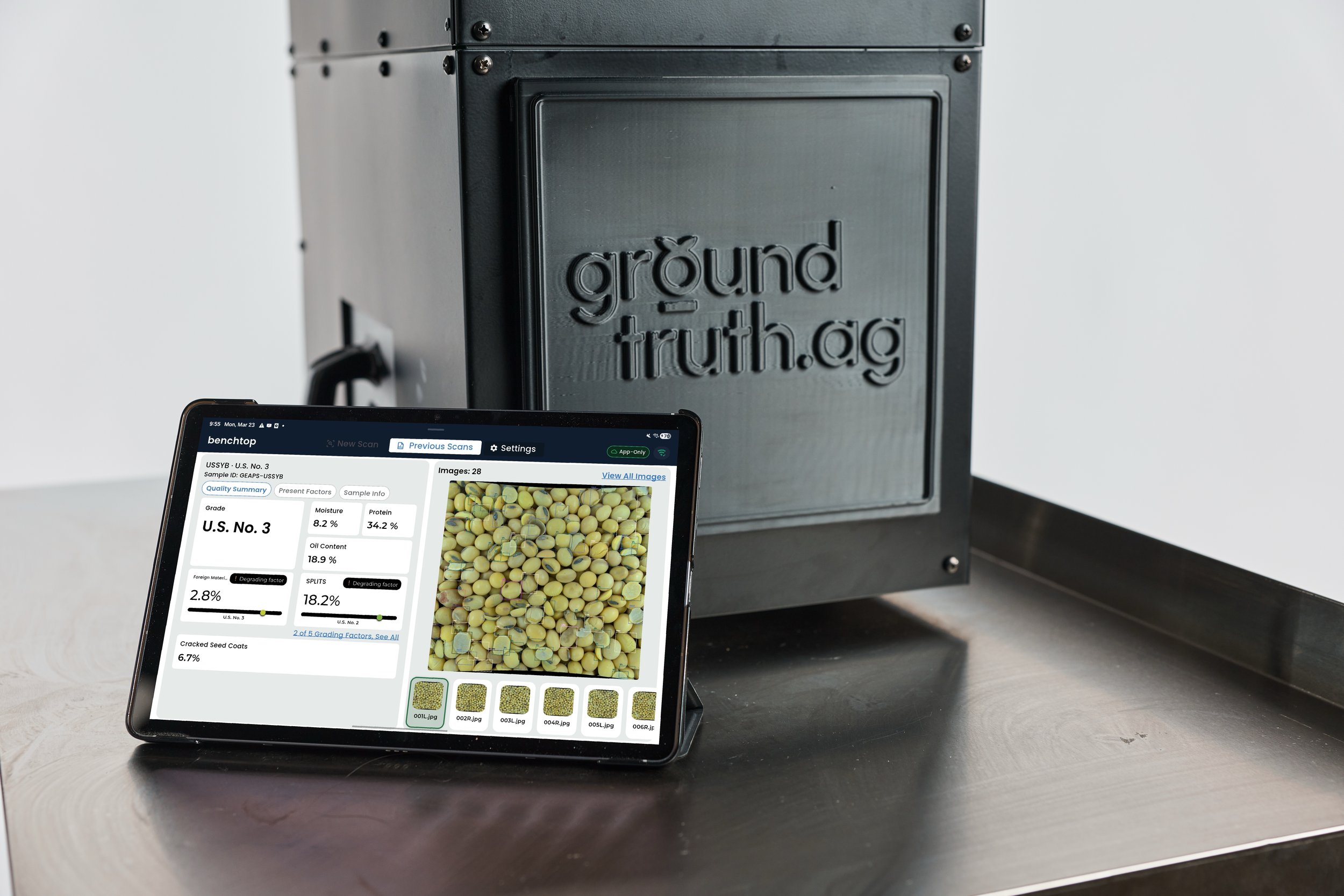
Our benchtop unit uses Near-Infrared Spectroscopy (NIR) to measure moisture in soybeans and a growing range of other crops. NIR works by directing light at a grain sample and analysing how the grain absorbs and reflects different wavelengths. Because water absorbs light in a specific and predictable way, NIR is well suited for detecting moisture content quickly and without damaging the sample.
That measurement is then interpreted through our machine learning models, which have been trained on real grain samples across a range of conditions. As more samples move through the system, the models continue to improve, becoming better at handling the variability that shows up in real harvest and intake scenarios.
The result is a moisture reading that is fast, repeatable, and reflective of how grain presents in practice.
Why That Matters
Moisture is often one of the first measurements teams rely on at intake, and small differences can have immediate implications.
A faster and more consistent measurement helps reduce uncertainty at that moment. Grading teams get a result they can act on, whether that is for pricing, storage planning, or next steps in handling the grain.
For operations managing high volumes, consistency across shifts, operators, and sample types is just as important as speed. Having a measurement that holds up across those conditions supports smoother workflows and more aligned decision making.
How Ground Truth Ag Can Help
Ground Truth’s benchtop system is designed to support moisture measurement as part of the grading process.
By delivering fast, repeatable results within the existing workflow, it helps bring more consistency to how moisture is assessed across loads, without adding complexity to day to day operations.