
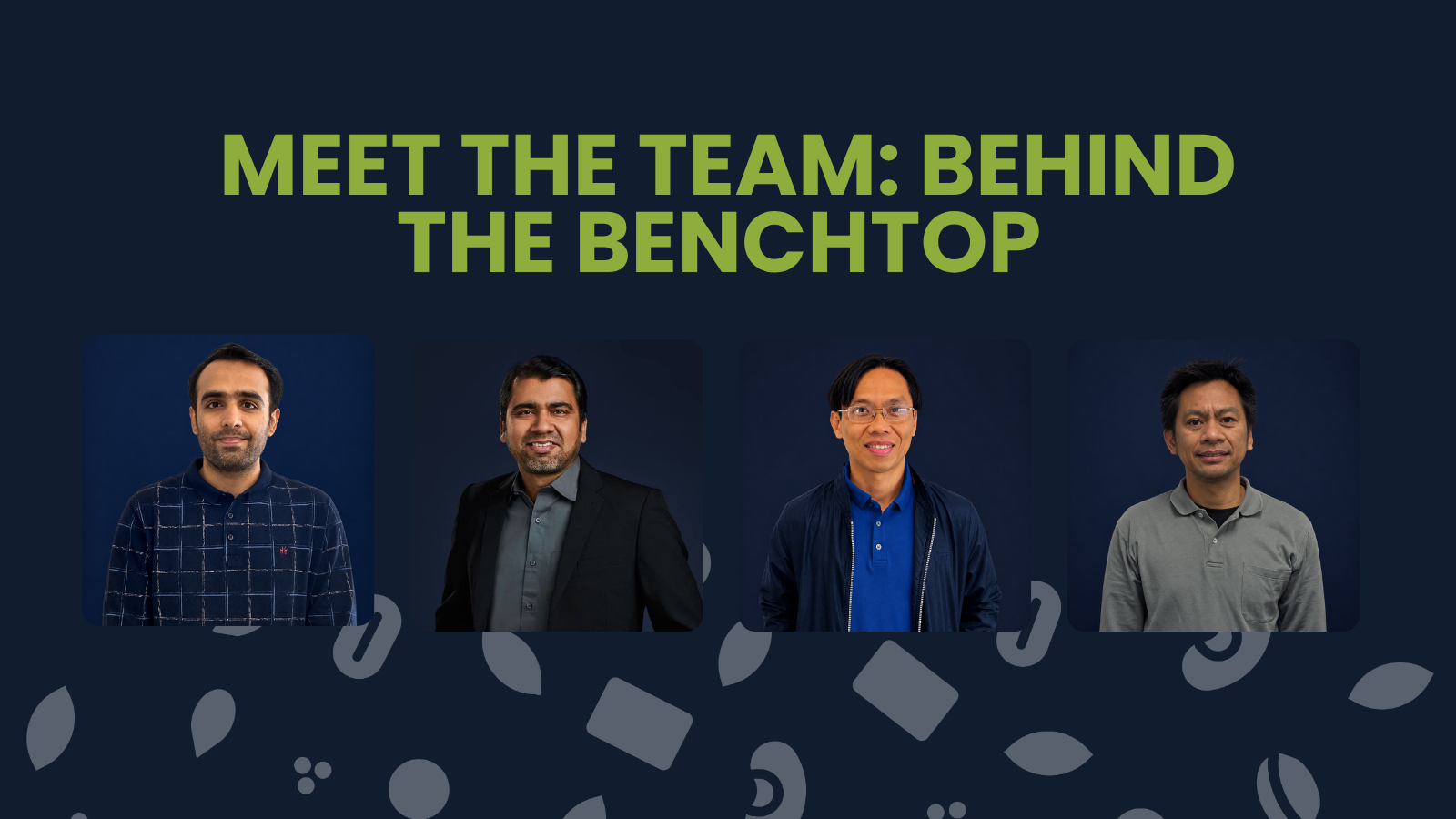
When you pour a grain sample into our benchtop and receive results a few minutes later, there is a lot happening inside the machine. Grain needs to move through the unit. Cameras need to capture the right images. Sensors, electronics, and mechanical components all need to work together. And once one unit is working, we need to be able to build the next one to the same standard. Behind all of that is a team bringing different areas of engineering, manufacturing, and problem solving together.
You may have already met them individually through our Meet the Team series. Now, we’re taking a look at how Duy Do, Fahad Shah, Bonifacio Jr. (Jun) Cadelina, and Shubham Bajaj work together to help bring our Benchtop units to life.
It Starts with the Design
Before the components come together on the shop floor, someone has to figure out how they should fit and work together. That is where Mechanical Engineer Duy Do comes in. Duy joined Ground Truth Ag with more than 20 years of experience in automatic transmission design. Interestingly, his Ground Truth Ag journey did not begin in engineering. He first joined the company as an intern working as a Grain Data Collector before transitioning into his current mechanical engineering role. Today, Duy helps develop and design the physical components that make up our technology.
Moving from automotive engineering into agriculture brought a completely new set of problems to solve. Grain is a biological material, and building equipment that can reliably move, handle, and analyze it requires the team to account for the variability that comes with it. For Duy, that challenge is part of what makes the work interesting. Each new design, adjustment, and problem is another opportunity to learn.
Bringing the Electronics Together
Of course, the benchtop is more than mechanical components. Sensors, cameras, controls, and other electronics need to communicate and operate alongside the mechanical design. Fahad Shah, Electronic Systems Engineer, helps bring those pieces together. Fahad was drawn to Ground Truth Ag because the work allowed him to bring together mechanical engineering, electrical engineering, and computer science rather than working within just one area.
That overlap becomes especially important when developing a product from the ground up. An adjustment to one part of the machine can have an impact somewhere else. Mechanical components need to work with electrical components. Hardware needs to communicate with software. A solution needs to work not just as an idea, but as part of the complete unit.
For Fahad, being involved throughout that process has been one of the most rewarding parts of working at Ground Truth Ag. He has been able to see the technology move through design, prototyping, and into production while working alongside the rest of the team to solve problems along the way.
From Drawings to a Benchtop
Eventually, all of those designs need to become a physical machine. That is where Bonifacio Jr. (Jun) Cadelina, General Assembler, comes in. Jun works from the team’s mechanical and electrical engineering drawings to complete subassemblies, wiring, integration, and ultimately turn individual components into a finished Benchtop.
He brought more than two decades of automotive experience to Ground Truth Ag, including precision assembly, process improvement, and advanced training with Toyota Motor Philippines. But building at a startup is a little different from working on an established production line.
As the benchtop has evolved, so has the way we build it. Jun does more than assemble what is in front of him. His experience helps the team identify where processes can improve, what tools could make assembly more efficient, and how we can continue building units consistently as production grows. The feedback also works both ways. When something can be made easier to assemble or a process can be improved, those learnings can make their way back into how the benchtop is designed and built.
Where Everything Meets
Between engineering and assembly, there is another important part of the process: making sure all of those systems work together. As our Mechatronics Technician, Shubham Bajaj works at the intersection of mechanics, electronics, and computing.
His background in Mechatronics Engineering, Automation, and Robotics makes him well suited to a machine where those disciplines constantly overlap. His work includes troubleshooting hardware, experimenting with improvements, and helping the team find ways to make the Benchtop easier to build and operate.
It also means asking a lot of questions. Why is something behaving this way? Could this component work differently? Can a process be simplified? What happens elsewhere in the machine if we make this change? Those questions help turn individual improvements into something that works across the complete benchtop.
Building Is a Team Effort
Duy, Fahad, Jun, and Shubham may have different job titles, but building a Benchtop is not a straight line where one person finishes their work and simply hands it to the next. It is a loop. A mechanical change can create an electrical consideration. Something discovered during assembly can lead to a design improvement. Troubleshooting can uncover a better way to build a component. And as more units are produced and used, those learnings come back to the team.
That collaboration has been part of the benchtop’s development from the beginning. Our technology may combine Machine Vision, Near Infrared Spectroscopy, Machine Learning, software, and a lot of engineering, but ultimately, it takes people to bring all of those pieces together.
So, the next time you see one of our benchtops, you now know a few more of the people behind the machine.